

Male Infertility Treatment
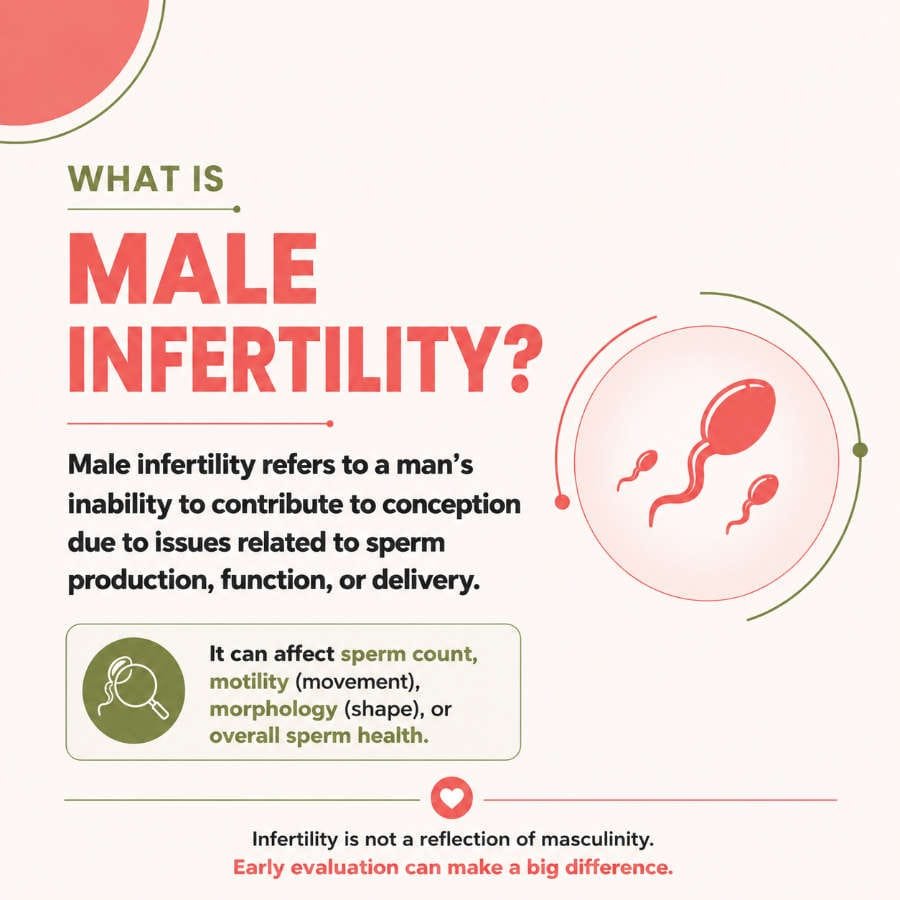
In roughly two out of every five couples struggling to conceive, a male factor is contributing to the picture. At CIFAR, we help men understand what’s happening, why it’s happening, and what can be done about it — with clear answers and a plan built around your family’s goals.
| ~30–40% of infertility cases involve a male factor {who report} https://www.ncbi.nlm.nih.gov/books/NBK562258/ | 1 in 20 men has a lower-than-average sperm count | 15–20 min for a first semen analysis at CIFAR |
What Can Affect Male Fertility
Male fertility depends on the testes producing enough healthy sperm, those sperm moving freely through the reproductive tract, and successful delivery during intercourse. A problem at any of these stages can affect the chances of conception — and often more than one factor is at play.
- Sperm production issues — low count (oligozoospermia), poor movement (asthenozoospermia), or abnormal shape (teratozoospermia) are the most frequently identified findings. (Read : Azoospermia vs. Oligospermia)
- Varicocele — enlarged veins in the scrotum are one of the most common, and most correctable, causes of reduced sperm quality.
- Hormonal imbalance — low testosterone, thyroid disorders, or elevated prolactin can disrupt the signals that drive sperm production.
- Blockages — a blockage in the tubes carrying sperm, from infection, prior surgery, or a condition present from birth, can prevent sperm from reaching the ejaculate.
- Genetic factors — conditions such as Klinefelter syndrome or small deletions on the Y chromosome can affect sperm production and are identified through targeted testing.
- Lifestyle & environment — smoking, heavy alcohol use, obesity, prolonged heat exposure, high stress, and certain medications or occupational exposures can all lower sperm quality.
- Past illness or treatment — mumps after puberty, undescended testes in childhood, testicular injury, or previous chemotherapy/radiation can each play a role.
- Sexual function — erectile difficulty, retrograde ejaculation, or timing issues can limit natural conception even when sperm quality is otherwise normal.
You Don’t Need to Wait a Year to Ask Questions
General guidance suggests seeing a specialist after 12 months of trying without success, or after 6 months if the female partner is over 35. But we encourage an earlier visit if you notice any of the following, since these can point to a cause worth addressing sooner:
- A history of undescended testicle(s), testicular injury, or surgery in the groin or scrotum
- Difficulty with erections, ejaculation, or low sex drive
- Small or unusually firm testicles, or a visible/palpable swelling in the scrotum
- A family history of fertility problems, or prior chemotherapy/radiation treatment
How We Find the Answer?
Diagnosis is built step by step, each test narrows down the picture before we move to the next. Most men complete the initial work-up within a single visit.
- History & physical examination — a private conversation about your health, lifestyle, and any past conditions, followed by a focused physical examination.
- Semen analysis — the core test; it looks at sperm count, movement, shape, and volume. We usually recommend this be repeated once, a few weeks apart, since results can vary.
- Hormonal blood work — testosterone, FSH, LH, and thyroid levels help explain what’s happening upstream in sperm production.
- Scrotal ultrasound (if needed) — used to check for a varicocele, blockage, or structural issue that a physical exam alone can’t confirm.
- Specialised testing (if needed) — genetic screening or sperm DNA fragmentation testing, reserved for specific findings that call for a closer look.
CIFAR’s Male Infertility Treatment in gurgaon
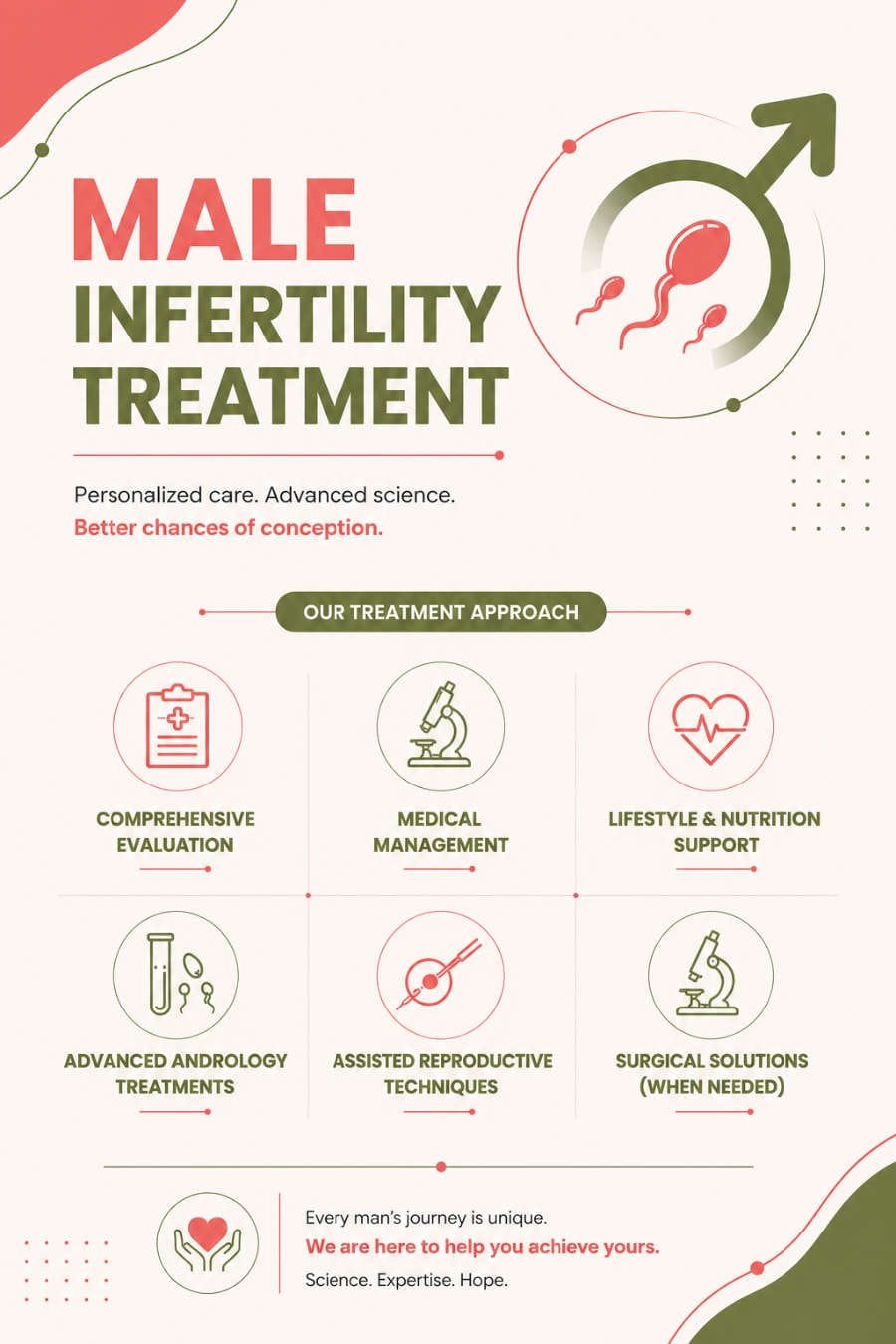
There is rarely a single, one-size-fits-all treatment for male infertility. Once we know what’s driving it, we build a plan around it, starting with the simplest effective option.
- Lifestyle — weight management, quitting smoking, reducing alcohol, and limiting heat exposure can measurably improve semen quality over 2–3 months.
- Medical therapy — correcting a hormone imbalance, treating an infection, or adjusting medication can restore sperm production in some men.
- Surgical correction — a day-care procedure to correct a varicocele or reconnect a blocked tube, aimed at improving natural conception chances.
- Sperm retrieval (TESA / TESE / micro-TESE) — when sperm are absent from the ejaculate, we can often retrieve them directly from the testicle for use in IVF/ICSI.
- Assisted reproduction (IUI, IVF & ICSI) — for moderate or severe male factor infertility, ICSI, injecting a single sperm directly into the egg, offers strong success rates.
- Donor sperm — for couples who choose it, donor sperm remains a well-established, carefully counselled option.
A Note From Our Director
“Male infertility carries a quiet weight that many men don’t feel able to talk about. My first goal in every consultation is to take that weight off the table — to explain, plainly and without judgment, what the tests mean and what our options genuinely are. Fertility care works best as a shared journey, and the male partner’s evaluation should never be an afterthought.”
Dr. Puneet Rana Arora
Founder & Director, CIFAR — FRCOG (UK), MSc Reproduction & Development (Bristol, UK)
SCIENCE & Evidence-based care, delivered with patience
Dr. Arora trained and practised in reproductive medicine within the UK’s National Health Service for over a decade, including at St Mary’s Hospital, Manchester, before founding CIFAR in Gurugram. That grounding shapes how the centre treats every patient today.
Both partners, evaluated together
We assess the male partner with the same rigour as the female partner, from the very first visit.
Simplest effective step first
We don’t default to IVF. Wherever a lifestyle change, medication, or a minor procedure can help first, we start there.
Most Advanced Lab
Our lab and clinical protocols follow nationally accredited quality benchmarks, from semen analysis to embryology.
A team, not just a doctor
Andrology, embryology, and counselling support work together around your treatment plan.
Answers Before You Ask
Does a normal semen analysis rule out male infertility?
Not entirely. Semen parameters can vary between samples, and some causes, such as sperm DNA fragmentation or a partial blockage, aren’t always visible on a standard report. Your doctor will tell you if further testing is worthwhile.
Can male infertility be reversed?
Often, yes, especially when the cause is a varicocele, a hormonal imbalance, an infection, or a lifestyle factor. Even when it can’t be fully reversed, assisted reproduction techniques such as ICSI can frequently still achieve a pregnancy using very few sperm.
Is treatment only about IVF?
No. Many men improve their fertility through targeted medical treatment or a day-care surgical procedure alone, without needing IVF at all.
How long does a full evaluation take?
An initial consultation and semen analysis can usually be done in a single visit. A complete picture, including a repeat semen test and any specialised investigations, typically takes 3–6 weeks.
Meet Our Professional