Medically Reviewed
By Dr. Puneet Rana Arora : Founder & Director, CIFAR — Centre for Infertility & Assisted Reproduction, Gurugram FRCOG (Royal College of Obstetricians & Gynaecologists, UK) | MSc Reproduction & Development, University of Bristol, UK
Last Review Date : 07 Sep, 2026
If you or your partner has been diagnosed with a mitochondrial disease — or if it runs in your family — questions about starting a family can feel overwhelming.
- Will I pass this on to my child?
- Can I still have a biological baby?
- What choices do I actually have?
These are some of the most common questions that patients ask us whenever they are coming for consultation at CIFAR, and this guide is designed to explain them in straightforward language so that you may walk into your next session feeling informed, not afraid.
What Is Mitochondrial Disease, in Simple Terms?
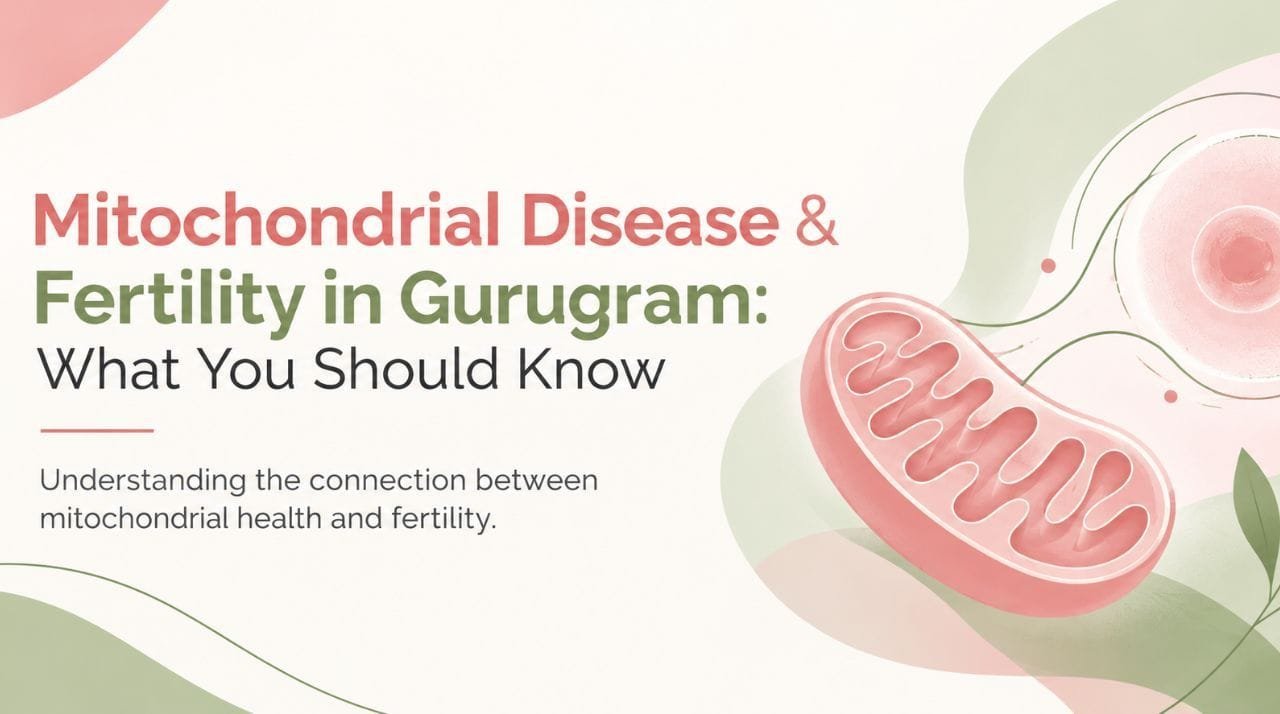
Mitochondria are the tiny “power plants” inside almost every cell in your body, converting food into the energy your organs and muscles need to function. Mitochondrial disease happens when these power plants don’t work properly, and it can affect the brain, muscles, heart, eyes, or several organs at once — with symptoms ranging from mild fatigue to serious, life-limiting conditions in children.
What makes mitochondrial disease unique from a fertility standpoint is how it’s inherited:
- Nuclear DNA–related mitochondrial disease follows classic inheritance patterns (similar to many other genetic conditions), meaning the risk to a child can often be calculated fairly precisely.
- Mitochondrial DNA (mtDNA)–related disease is passed almost exclusively from mother to child, because mitochondria are inherited through the egg, not the sperm. A mother can carry a mix of healthy and mutated mitochondria (called heteroplasmy), and the exact proportion passed to each child can vary — which is part of why family planning conversations need to be personalized rather than generic.
How Does This Affect Fertility and Family Planning?
Having mitochondrial disease, or being a carrier, does not automatically mean you cannot have a healthy, genetically related child. It does mean your reproductive journey benefits from specialized planning, ideally before conception. The main pathways patients discuss with their fertility team include:
- Preimplantation Genetic Testing (PGT-M): Embryos created through IVF are tested before transfer, allowing the clinical team to prioritize embryos with a low or undetectable disease-causing mutation load. This is well established for nuclear-gene mitochondrial disorders and increasingly used, with some limitations, for mtDNA-related conditions.
- Egg (Oocyte) Donation: For women with high-risk mtDNA mutations, using a donor egg removes the risk of passing on the mitochondrial mutation entirely, since mitochondria come from the egg. This doesn’t offer a genetic link through the mother’s DNA, but it does allow the intended mother to carry and deliver the pregnancy.
- Prenatal Diagnosis: Testing during an established pregnancy can provide information about mutation levels, though for mtDNA disorders this can be harder to interpret and may raise difficult decisions for some families.
- Mitochondrial Replacement Therapy (MRT): An emerging technique which is under research trials that replaces a mother’s affected mitochondria with healthy donor mitochondria while keeping her own nuclear DNA.The “right” path is different for every patient — it depends on whether the mutation is in nuclear or mitochondrial DNA, the specific mutation and heteroplasmy level, your fertility profile, and, just as importantly, what feels right for you and your partner emotionally.
Dr. Puneet Rana Arora’s Perspective
Dr. Puneet Rana Arora, Founder & Director of CIFAR – Centre for Infertility & Assisted Reproduction, Gurugram, shares her clinical approach to counseling patients affected by mitochondrial disease:
“In my years of practice, the patients who come to us with a mitochondrial disease diagnosis in the family are often carrying two burdens at once — the medical reality of the condition, and the emotional weight of not knowing whether they can safely have a child of their own. My first priority is always to slow down and make sure they understand their options clearly, without medical jargon getting in the way. Multi disciplinary counselling involving geneticist is also offered.
“What I want every patient to know is this: a mitochondrial disease diagnosis is the beginning of a conversation with your fertility specialist and a clinical geneticist — not the end of your family-building journey. Genetic counseling before conception is one of the most valuable steps a couple can take, because it lets us map out real, personalized options instead of relying on general assumptions. Whether that means preimplantation genetic testing, considering egg donation, or simply monitoring a pregnancy closely, our role is to walk that path together with the family, at their pace, with complete honesty about what current science can and cannot guarantee.
“Above all, I encourage patients not to carry this alone. Bring your questions, bring your fears, and let us help you build a plan that’s grounded in evidence and in empathy.”
What Should You Do Next?
If mitochondrial disease affects you, your partner, or your family history, here’s a practical starting point:
- Seek genetic counseling early — ideally before you start trying to conceive, so testing and planning aren’t rushed.
- Ask for mutation-specific information, not just a general diagnosis — nuclear vs. mitochondrial DNA origin changes your options significantly.
- Discuss all pathways with your fertility specialist — PGT-M, egg donation, and monitored natural conception can all be reasonable choices depending on your situation.
- Give yourself permission to grieve, ask questions, and take time — this is a medical decision, but it’s also a deeply personal one.
CIFAR words….
During this world mitochondrial disease week (September 14 to September 20, 2026), we want to highlight that this condition adds real complexity to family planning, but it does not close the door on parenthood. With the right genetic information, a specialized fertility team, and a plan built around your specific situation, many patients go on to have healthy pregnancies and healthy children.
At CIFAR, every conversation starts with listening—because your path forward should be built around your biology and your story, not a one-size-fits-all protocol.
This article is for general educational purposes and is not a substitute for personalized medical advice. Please consult your fertility specialist and genetic counselor to discuss options specific to your diagnosis.
