
Medically Reviewed
By Dr. Puneet Rana Arora : Founder & Director, CIFAR — Centre for Infertility & Assisted Reproduction, Gurugram FRCOG (Royal College of Obstetricians & Gynaecologists, UK) | MSc Reproduction & Development, University of Bristol, UK
Last Review Date : 24 Oct, 2026
The two-week wait after an embryo transfer is one of the hardest parts of the entire IVF journey. Every twinge, every mood swing, every day on the calendar feels loaded with meaning. So when the blood test finally comes back and the result is a negative beta-hCG, it can feel like the ground has shifted under you — even if you told yourself you were “prepared for anything.”
If you’re reading this after getting that result, we want to say two things clearly: your disappointment is valid, and a negative result today does not erase the possibility of a positive one tomorrow. Let’s walk through what this test actually means, why cycles don’t always end in a positive result, and what your next steps can look like.
What Is the Beta-hCG Test, Exactly?
Beta-hCG (human chorionic gonadotropin) is a hormone produced by the cells that will eventually form the placenta, once an embryo has implanted in the uterine lining. After an embryo transfer, the CIFAR fertility team will usually schedule a blood test around 9–14 days later to measure this hormone.
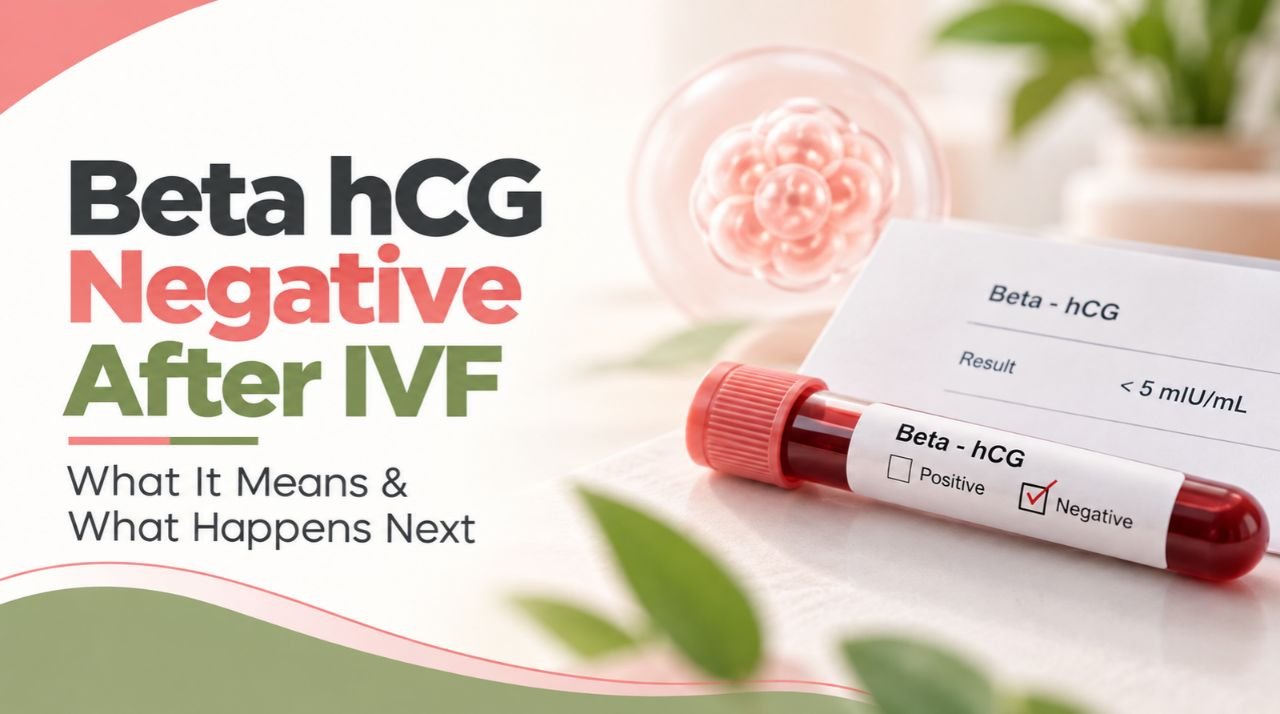
- A positive result (generally above 5 mIU/mL, though thresholds vary by lab) suggests implantation has occurred the higher the value,the more it confirms the pregnancy implantation
- A negative result means the hormone wasn’t detected, which typically means implantation did not take place during this cycle.
This is a blood test, not a judgment on your body, your effort, or your worth as a patient going through treatment.
Why Might a Cycle Not Result in a Positive Beta-hCG?
It’s natural to want a reason — something concrete to point to. Sometimes there is a clear explanation; often, it’s a combination of small factors rather than one single cause. Some of the more common contributors include:
- Embryo-related factors: chromosomal abnormalities in the embryo are among the most common reasons implantation doesn’t happen, especially as maternal age increases.
- Endometrial receptivity: the uterine lining needs to be at the right thickness and in the right hormonal “window” for an embryo to implant.
- Uterine factors: conditions like fibroids, polyps, adhesions, or a thin lining can affect implantation.
- Hormonal or immunological factors: imbalances or immune responses can occasionally interfere with implantation.
- Timing and technique: the precise timing of the transfer and how it’s carried out also play a role, though clinics take great care to optimize this.
- Unexplained: in a meaningful number of cycles, no clear cause is found even after review — this is frustrating, but it’s also common, and it doesn’t mean the next cycle will follow the same pattern.
It’s worth remembering that IVF success varies by age, diagnosis, and embryo quality.
Give Yourself Permission to Grieve
Many patients describe a negative beta-hCG as a loss . You may feel grief, anger, numbness, or a strange mix of all three. Some people feel the need to immediately “make a plan” for the next step; others need to step back before they can think about IVF at all. Both responses are normal.
Dr Puneet gentle suggestions:
- Allow yourself the time you need before jumping into decisions about the next cycle.
- Talk to your partner about how each of you is processing this — it’s common for partners to grieve differently and on different timelines.
- Consider connecting with a counselor experienced in fertility-related loss, or a support group of people who understand this specific kind of disappointment.
- Be mindful of well-meaning but unhelpful comments from others (“just relax,” “it’ll happen naturally”) — you’re allowed to set boundaries around what you discuss and with whom.
If sadness feels overwhelming or lingers in a way that’s affecting your daily life, please don’t carry that alone — speaking with your treating doctor or a mental health professional is a normal, supportive part of fertility care, not a sign of weakness.
What Happens Next, Medically?
Once the immediate news has settled, your fertility team will usually guide you through a structured follow-up:
- Confirming the result. Your doctor may repeat the test after a couple of days if there’s any ambiguity, to rule out a very early or borderline reading.
- A follow-up consultation. This is where your doctor reviews the entire cycle with you — the stimulation protocol, egg and sperm quality, embryo grading, endometrial lining, and the transfer itself — to look for patterns or clues.
- Additional testing, if recommended. Depending on your history, your doctor might suggest tests such as an Endometrial Receptivity Assay (ERA), hysteroscopy to examine the uterine cavity, thyroid and other hormonal panels, immunological or thrombophilia screening, or genetic carrier testing.
- Deciding on the next step. If you have additional frozen embryos, a Frozen Embryo Transfer (FET) may be considered after your body has had time to recover. If not, your doctor will discuss whether another stimulation cycle is appropriate, and whether any adjustments to the protocol are worth making.
- Timing. Back to back embryo transfer can be planned provided emotional healing has happened. Most clinics recommend waiting at least one to three menstrual cycles before the next embryo transfer, to allow your body — and often your emotions — time to reset.
Every patient’s path forward looks a little different, which is why this conversation with your doctor matters as much as the test result itself.
Dr. Puneet Rana Arora’s Perspective
Dr. Puneet Rana Arora, Founder & Director, CIFAR – Centre for InFertility and Assisted Reproduction, Gurugram
“A negative beta-hCG is one of the most difficult moments in a couple’s fertility journey, and I always tell my patients — this number tells us something about this cycle, not about your future chances of becoming parents. My approach has always been to sit down with the couple, go through the cycle in detail, and be honest about what we know and don’t know.
Sometimes the answer is clear — an embryo quality issue, a lining that wasn’t quite ready. Sometimes we genuinely don’t find a single cause, and that can be harder to accept than a clear diagnosis, but it isn’t a dead end.
What I emphasize to every patient is that we treat the couple, not just the cycle. That means looking closely at uterine health, hormonal balance, and — where relevant — investigations like an ERA or hysteroscopy before we plan the next attempt, rather than simply repeating the same protocol. It also means acknowledging the emotional toll this takes. I encourage my patients to take the time they need before deciding on next steps, and I make sure they know that support — medical and emotional — is available to them throughout, not just during the treatment cycle itself.”
When to Reach Out to Your Doctor Right Away
While a negative result itself is usually not a medical emergency, contact your clinic promptly if you experience:
- Heavy vaginal bleeding or severe abdominal pain
- Fever, dizziness, or fainting
- Symptoms of Ovarian Hyperstimulation Syndrome (OHSS), such as significant bloating, nausea, or rapid weight gain, if you were recently stimulated
These symptoms warrant a call regardless of your test result.
A Few Common Questions
- Does a negative beta-hCG mean IVF won’t work for me?
No. A single negative cycle doesn’t predict the outcome of future cycles. Many patients who have one or more unsuccessful transfers go on to have successful pregnancies, sometimes after adjustments to their protocol.
2. How soon can I try again?
This depends on your individual situation, whether you have frozen embryos available, and how your body needs to recover. This is worth discussing with your doctor. After one unsuccessful cycle, some clinics proceed directly to another transfer if there’s no obvious concern; after repeated implantation failure, further investigation is usually recommended.
Your doctor will advise a realistic timeline.
You Are Not Alone in This
A negative beta-hCG result is a hard chapter, not the end of the book. At CIFAR, our team works with you to understand what happened, explore the options available, and move forward at a pace that feels right for you — medically and emotionally.
If you’d like to discuss your results or plan your next steps, our team at CIFAR is here to listen and guide you through it.
