

Medically Reviewed
By Dr. Puneet Rana Arora : Founder & Director, CIFAR — Centre for Infertility & Assisted Reproduction, Gurugram FRCOG (Royal College of Obstetricians & Gynaecologists, UK) | MSc Reproduction & Development, University of Bristol, UK
Last Review Date : 30 July, 2026
Your Mental Health Matters as Much as Your Fertility Treatment — And Now, India Agrees
If you’re going through fertility treatment right now, you already know the physical side of it — the scans, the injections, the waiting. What often gets less attention is the emotional weight that comes with it: the grief, the anxiety, the sense of your body being “on trial” every month. This week, that emotional side got some important validation on the national stage.
Mental Wellness Just Became a National Health Priority
At the 16th BRICS Health Ministers’ Meeting held in Chandigarh this week, India’s Health Secretary Punya Salila Srivastava announced that the country introduced two new priority areas under its BRICS Chairship for 2026: the BRICS Mission for Healthy Lifestyles and, for the first time, the Promotion of Mental Wellness. Delegates from BRICS member and partner nations worked these into shared health commitments, with a focus on strengthening mental health services, reducing stigma, and weaving mental health into mainstream public health systems — rather than treating it as a separate, optional add-on.
The commitment went beyond words. By the close of the meeting, India announced the establishment of the BRICS Network of Centres of Excellence on Mental Wellness, to be coordinated by NIMHANS (the National Institute of Mental Health and Neuro Sciences) — a concrete institutional mechanism meant to strengthen mental health research and cooperation across member countries going forward.
That shift matters far beyond policy circles. It reflects a growing recognition, right up to the level of national health leadership, of something clinicians working closely with patients have observed for years: mental health is not separate from physical health — it’s part of the same treatment.
Dr. Puneet Rana Arora’s Perspective
“Infertility is not just a medical diagnosis — it is an emotional journey. As India rightly recognizes mental wellness as a national health priority, fertility care must also move beyond treating reproductive organs to supporting the emotional well-being of every couple. Better mental health can improve treatment experiences, strengthen coping abilities, and ultimately contribute to a better quality of life during fertility treatment.”
Nowhere is that truer than in fertility care.
What the Research Shows
This is exactly the space where Dr. Puneet Rana Arora, from the Department of Fertility and Gynaecology at the Centre of Infertility and Assisted Reproduction (CIFAR), Delhi, has been doing focused work. In a study co-authored with researcher Nitya Khanna (Amity University) — Exploring Fertility Quality of Life and Mental Health Parameters with Coping Styles among Women Undergoing Infertility Treatment, published in the Indian Journal of Positive Psychology (17(2), 271–276, 2026) — the two examined how mental health and coping styles relate to fertility-specific quality of life in women undergoing infertility treatment.
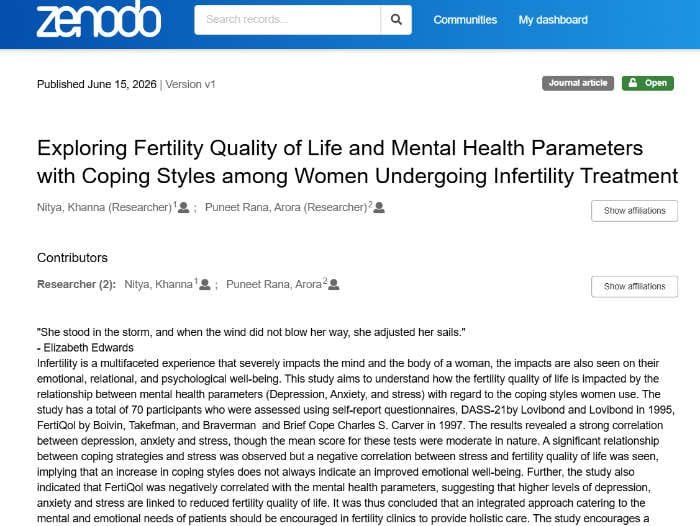
The study looked at 70 women, using three established tools: a stress-and-mood screening scale (DASS-21), a fertility-specific quality-of-life measure (FertiQol), and a scale mapping different coping strategies (Brief COPE). A few findings stand out:
- Depression, anxiety, and stress move together. Women who scored higher on one of these tended to score higher on the others too — though on average, the levels seen were moderate rather than extreme. In other words, emotional strain during infertility treatment is common, not a sign that something is unusually “wrong” with you.
- Coping “more” doesn’t automatically mean coping “better.” How actively women used coping strategies was linked to their stress levels — but higher use of coping strategies didn’t reliably translate into better emotional wellbeing. This is an important, humanizing finding: there’s no single “right way” to cope, and simply trying harder to manage isn’t always the answer.
- Quality of life and mental strain are closely intertwined. As depression, anxiety, and stress increased, fertility-related quality of life dropped. The two move in opposite directions — a data-backed way of confirming what many patients already feel: the emotional toll of treatment is inseparable from how “livable” the whole experience feels.
The core conclusion: an integrated approach — one that pays as much attention to a patient’s emotional and psychological needs as it does to hormone levels and embryo counts — should be standard in fertility care, not an optional extra. The study frames this as a call for a biopsychosocial model of care within the Indian fertility treatment context.
Why This Should Feel Reassuring, Not Alarming
If you recognize yourself in any of this — the low moods, the exhaustion, the sense that your coping strategies aren’t “working” the way you hoped — this research, alongside the national policy shift, is telling you two things:
You are not failing at this. The emotional difficulty of infertility treatment is well-documented and expected, not a personal shortfall.
Asking for psychological support isn’t separate from your fertility treatment — it is your fertility treatment. Good clinics are increasingly expected to build this in, not leave you to manage it alone.
What You Can Do, Starting Now
- Talk to your fertility team about emotional support, not just protocols. Ask if counselling or a mental health professional is part of your care pathway — and if not, ask for a referral.
- Give yourself permission to not have it “figured out.” The research shows even highly engaged coping doesn’t guarantee less stress — so be gentle with yourself rather than treating your emotional state as another test to pass.
- Notice what coping actually helps you personally, rather than assuming more effort is always better. That might be talking to someone, journaling, structured relaxation, or protecting time away from treatment-related thinking.
- Consider peer or group support. Talking to others going through the same process can reduce the isolation that often makes the emotional side of infertility harder than the physical side.
- If low mood, anxiety, or stress are affecting your daily functioning, that’s a signal to bring it to a professional — not a sign to push through quietly.
CIFAR’s Point of View
At CIFAR, fertility treatment is viewed through a holistic lens. The BRICS focus on mental wellness validates what fertility specialists have observed for years:
- Emotional stress is a common part of infertility.
- Mental well-being directly influences a patient’s treatment journey and quality of life.
- Compassionate counselling, clear communication, and emotional support should be integrated with evidence-based fertility care.
- Fertility success should be measured not only by pregnancy rates but also by improvements in patients’ overall well-being throughout treatment.
CIFAR believes fertility care should combine advanced reproductive medicine, psychological support, patient education, personalized treatment planning, and research-driven clinical practice.
The Bigger Picture
It’s a meaningful moment when a national health policy conversation and frontline clinical research point in the same direction: mental wellness is not a footnote to fertility treatment — it’s central to it. As India pushes this agenda forward through BRICS, research like Dr. Arora’s work at CIFAR shows what “integrating mental health into care” should actually look like in practice, for the people living through it. You deserve care that treats your mind and body as one story, not two.
This article draws on public reporting of the 16th BRICS Health Ministers’ Meeting (Chandigarh, July 22–24, 2026) and the study “Exploring Fertility Quality of Life and Mental Health Parameters with Coping Styles among Women Undergoing Infertility Treatment” by Nitya Khanna and Dr. Puneet Rana Arora, published in the Indian Journal of Positive Psychology, 17(2), 271–276, 2026. It is intended for general patient information and is not a substitute for personalized medical or psychological advice.
